
How to Get DVA-Funded Psychology: GP Referrals, Veteran Cards and Treatment Cycles Explained
A step-by-step guide for veterans and current ADF members: which Veteran Card covers psychology, how Non-Liability Health Care works, what the GP referral must say, how the 12-session treatment cycle works, and how to see a psychologist with nothing to pay.
By ClearAccess Psychology · 25 October 2026
The short answer: if you have served at least one day of continuous full-time service in the Australian Defence Force, DVA will pay in full for treatment of any mental health condition, for as long as you need it, without you having to prove your service caused it. You need two things: a Veteran Card that covers mental health (a Gold Card, or a White Card with mental health listed), and a referral from your GP. A psychologist who accepts your Veteran Card must accept DVA's fee as full payment, so you pay nothing at any point.
You may already be closer than you think. Many veterans already hold the card they need and simply haven't used it yet. This guide walks through each step, so that by the end you will know exactly what to bring to your GP and what to say when you contact a psychologist.
Checked against the Department of Veterans' Affairs website and DVA's Schedule of Fees for psychologists on 25 October 2026. DVA rules change from time to time; call 1800 VETERAN (1800 838 372) if anything here differs from your situation.
Need help right now? Open Arms – Veterans & Families Counselling answers 24 hours a day on 1800 011 046. No card or referral needed. In an emergency call 000, or Lifeline on 13 11 14.
Who can get DVA-funded mental health treatment?
Under Non-Liability Health Care (NLHC), DVA funds treatment of all mental health conditions for:
- Current and former full-time members of the ADF with at least one day of continuous full-time service (CFTS), however long ago you served and whatever kind of service it was.
- Reservists with at least one day of CFTS. CFTS means full-time service in the permanent forces, being formally designated by Defence to be on full-time service, or being called out for full-time service by the Governor-General. Training days as a reservist do not count.
- Reservists without CFTS who have Disaster Relief Service, Border Protection Service, or were involved in a serious service-related training accident.
"Non-liability" means DVA pays without deciding whether your service caused the condition. You do not need to lodge a compensation claim, and you do not need to prove anything about what happened during your service.
Which Veteran Card do I need for psychology?
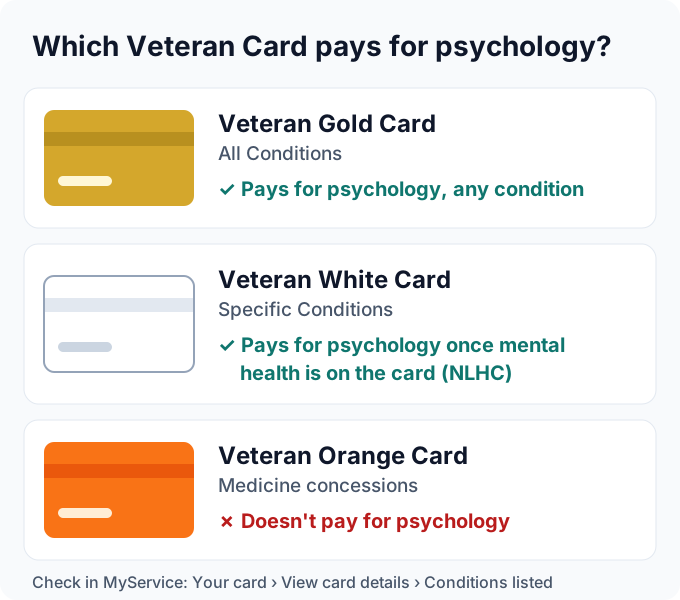
DVA issues three Veteran Cards. Only two of them pay for psychology.
| Card | Also called | Does it pay for psychology? |
|---|---|---|
| Veteran Gold Card | Veteran Card – All Conditions | Yes. Covers clinically necessary treatment for all conditions, including any mental health condition. |
| Veteran White Card | Veteran Card – Specific Conditions | Yes, for mental health, once mental health is added to the card under NLHC. Otherwise it covers only your accepted service-related conditions. |
| Veteran Orange Card | Pharmaceutical concession card | No. It gives concessions on some medicines and supplies, not treatment. |
How do I check whether my White Card covers mental health?
Log in to MyService, go to "Your card", choose "View card details", then "Conditions listed". You should see either "All mental health conditions – treatment only", or a specific mental health condition with "Treatment" or "Treatment Only" beside it. You can also call 1800 VETERAN (1800 838 372) or email NLHC@dva.gov.au and ask.
I don't have a White Card. How do I get one?
In most cases DVA sends a White Card automatically when you discharge with at least one day of CFTS. If you never received one, or it doesn't list mental health yet, you can:
- Apply online through MyService (lodge a Non-Liability Health Care claim), or
- Call 1800 VETERAN (1800 838 372), or
- Email NLHC@dva.gov.au, or
- Complete DVA's NLHC application form.
You may be asked for proof of identity. Once DVA approves the application you can start treatment straight away by showing your provider the NLHC acceptance letter, even before the physical card arrives or the condition appears on your digital card. If you paid for eligible treatment while waiting, DVA can reimburse costs from up to three months before it received your claim.
Do I need a GP referral to see a psychologist under DVA?
Yes. Every Veteran Card holder needs a valid referral to see a psychologist. The referral normally comes from your usual GP. For the first treatment cycle only, it can also come from a medical specialist, a treating hospital doctor, or a hospital discharge planner.
The referral can be on DVA's D904 referral form or a letter on the doctor's letterhead with the required details. It is not a Medicare Mental Health Treatment Plan: a DVA referral is separate, and it does not use up any of your Medicare sessions.
What to say to your GP
You don't need to have the words worked out. You might simply say: "I'm a veteran with a Veteran Card that covers mental health. I'd like a DVA referral to a psychologist." Your GP will talk with you about what has been happening and write the referral. If you already know which psychologist you want to see, take their name along. If you don't, your GP can refer you generally and you can choose a psychologist afterwards.
You may find it useful to print DVA's NLHC (mental health) fact sheet and take it with you.
Can my GP refer me to other services as well?
Yes. If your GP thinks it would help alongside psychology, they can also refer you for exercise physiology, physiotherapy or dietitian advice. Under NLHC these are fully funded too, usually as short-term support.
How many psychology sessions does DVA pay for?
There is no annual cap. DVA uses treatment cycles:
- One referral covers up to 12 sessions or one year, whichever ends first.
- At the start, your psychologist agrees treatment goals with you. At the end of the cycle, they send a short report to your GP.
- If more treatment is clinically needed, your GP writes a new referral for the next cycle.
- You can have as many treatment cycles as your GP decides you need.
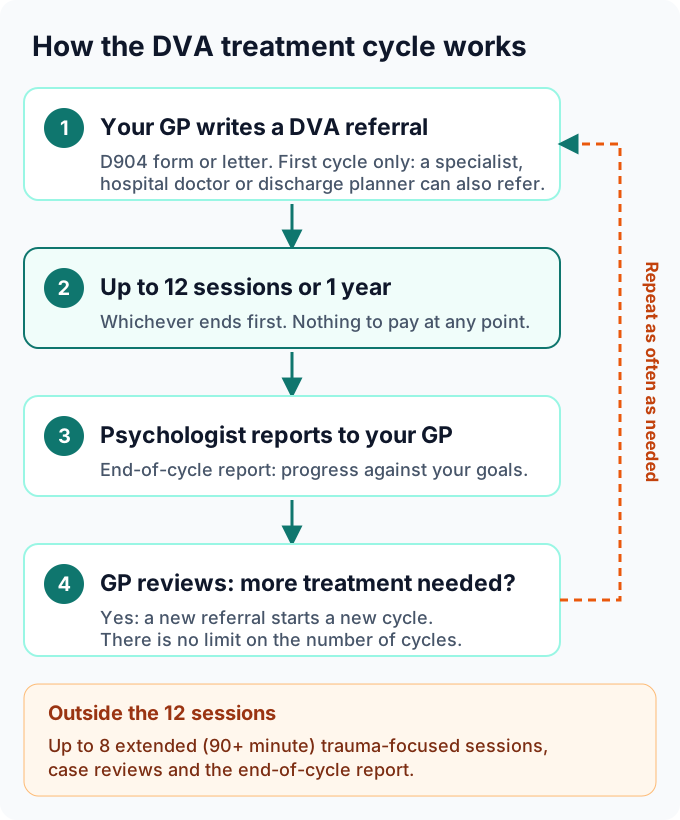
A few things sit outside the treatment cycle and don't use up your 12 sessions, including extended trauma-focused therapy sessions (see below), case reviews and the end-of-cycle report. Veterans with severe or complex needs can have tailored referral arrangements for up to 12 months through DVA's At Risk Client Framework, which your usual GP completes.
How does that compare with Medicare?
| DVA (Veteran Card) | Medicare Better Access | |
|---|---|---|
| Who refers | Your usual GP (or, for the first cycle, a specialist, hospital doctor or discharge planner) | A GP, psychiatrist or paediatrician, with a Mental Health Treatment Plan |
| Sessions | 12 per treatment cycle, unlimited cycles while clinically needed | Up to 10 individual sessions a calendar year |
| What you pay | Nothing. A provider accepting your card cannot charge a gap | Nothing only if the psychologist bulk bills; otherwise a gap |
| Extended trauma therapy | 90+ minute sessions funded for EMDR and exposure therapy | No equivalent item |
Can I have DVA psychology by telehealth?
Yes. DVA funds psychology by video, and by phone when video isn't available. The first session of each treatment cycle must be in person or by video, not phone. Group therapy must be in person. Telehealth means a psychologist anywhere in Australia can see you, which helps if you live regionally or there is no one near you who bills DVA.
What does DVA pay the psychologist, and can they charge me a gap?
By accepting your Veteran Card, the psychologist agrees to accept DVA's fee as full payment, and DVA's rules say they cannot charge you a gap fee. From 1 July 2026, DVA pays a psychologist $167.65 for a 50-minute-plus consultation in their rooms or by video, and $251.60 for a 90-minute-plus trauma-focused therapy session. Clinical psychologists are paid under their own, higher schedule.
If you ever receive a bill for treatment DVA covers, don't pay it: tell DVA on 1800 VETERAN.
What isn't covered?
- Couples counselling. DVA does not fund psychologists for relationship therapy, but Open Arms provides couples counselling free of charge.
- Treatment overseas under NLHC.
- More than about one session a week on an ongoing basis without prior approval. Your psychologist can ask DVA if you need more.
What about Open Arms?
Open Arms – Veterans & Families Counselling is funded by DVA and is free for anyone who has served at least one day in the ADF, and for their partners and families. You don't need a referral or a card, and it is outside the treatment cycle. Many veterans use Open Arms and a private psychologist at different times, or alongside each other. Call 1800 011 046 at any hour.
Your step-by-step checklist
- Check your card in MyService. Gold, or White with mental health listed? You're ready.
- No card, or no mental health on it? Lodge an NLHC claim through MyService or call 1800 VETERAN.
- See your usual GP and ask for a DVA referral to a psychologist.
- Find a psychologist who bills DVA directly. On ClearAccess Psychology, search by postcode and choose DVA, or browse DVA psychologists who offer telehealth. Every profile shows plainly what you will pay.
- Send an inquiry, mention your Veteran Card and your referral, and book your first session.
- Near the end of 12 sessions, see your GP for a new referral if you'd like to keep going.
Most people find the first step is the hardest one, and you have already taken it by reading this far.
Frequently asked questions
Do I need to prove my mental health condition was caused by my service?
No. Under Non-Liability Health Care, DVA pays for treatment of any mental health condition without deciding whether your service caused it. You don't need to lodge a compensation claim.
Does a DVA White Card cover psychology?
Yes, once mental health has been added to it under Non-Liability Health Care. In MyService it shows as "All mental health conditions – treatment only" or a specific mental health condition marked "Treatment". If it isn't listed, apply through MyService or call 1800 VETERAN.
Does the Orange Card cover psychology?
No. The Veteran Orange Card gives concessions on some medicines. For psychology you need a Gold Card or a White Card that covers mental health.
Do I need a Mental Health Treatment Plan to see a psychologist under DVA?
No. You need a DVA referral from your GP (on a D904 form or a letter), not a Medicare Mental Health Treatment Plan. Using DVA does not use any of your Medicare sessions.
How many sessions does DVA pay for each year?
There is no yearly limit. Each GP referral covers up to 12 sessions or one year, whichever ends first, and your GP can write as many new referrals as you clinically need.
Will I have to pay anything?
No. A psychologist who accepts your Veteran Card agrees to accept DVA's fee as full payment and cannot charge a gap. If you are sent a bill for DVA-covered treatment, don't pay it; call DVA.
Can reservists get DVA-funded psychology?
Yes, if they have at least one day of continuous full-time service, or Disaster Relief Service, Border Protection Service, or involvement in a serious service-related training accident.
Can my partner or children get DVA-funded psychology?
Families are not covered by NLHC, but Open Arms provides free counselling to partners and family members of anyone who has served, without a referral. Family members who hold their own Gold Card are covered for psychology.
Can I start before my card arrives?
Yes. Once DVA has approved your NLHC application, show your provider the acceptance letter. DVA can also reimburse eligible costs from up to three months before it received your claim.
Find a psychologist who bills DVA directly
When you're ready, search ClearAccess Psychology for psychologists who bill DVA, near you or by telehealth. You can narrow your search by what you'd like help with, such as PTSD, depression, anxiety, alcohol or drug use, sleep or anger and the move to civilian life. Our DVA psychology guide has a short summary you can share with a mate.
Sources
- DVA, Non-Liability Health Care (mental health) for veterans
- DVA, Clinical psychologists and psychologists (referrals, treatment cycle, couples counselling, trauma-focused therapy)
- DVA, Allied health treatment cycle
- DVA, Veteran Card
- DVA, Schedule of Fees – Psychologists, effective 1 July 2026
- Open Arms – Veterans & Families Counselling