
PTSD Treatment for Veterans Under DVA: What Works and How to Access It With No Gap
The treatments with the strongest evidence for PTSD (CPT, prolonged exposure, cognitive therapy and EMDR), what therapy with a psychologist looks like, and how DVA pays for all of it, including extended 90-minute trauma sessions.
By ClearAccess Psychology · 25 October 2026
The short answer: PTSD is very treatable. Australian guidelines recommend trauma-focused psychological therapy as the first treatment: cognitive processing therapy (CPT), prolonged exposure (PE), trauma-focused cognitive therapy, and EMDR. Most people who complete one of these therapies improve significantly. If you have served at least one day of continuous full-time service in the ADF, DVA pays for the whole course, including extended 90-minute trauma sessions, with nothing for you to pay. You need a Veteran Card that covers mental health and a referral from your GP.
Checked against DVA's published rules and the 1 July 2026 Schedule of Fees on 25 October 2026. This article is general information, not a diagnosis or treatment advice.
Need help right now? Open Arms answers 24/7 on 1800 011 046. In an emergency call 000, or Lifeline on 13 11 14.
What does PTSD look like in veterans?
Post-traumatic stress disorder can develop after experiencing or witnessing events involving threat, death or serious injury. In veterans it often shows up as a mix of:
- Re-experiencing: intrusive memories, nightmares, flashbacks, or a strong physical reaction to reminders.
- Avoidance: steering clear of people, places, conversations or thoughts that bring it back; keeping busy so there's no time to think.
- Feeling on guard: hypervigilance, scanning rooms, sitting with your back to the wall, being easily startled, poor sleep, irritability or anger.
- Changes in mood and thinking: guilt, shame, feeling numb or cut off from people, losing interest in things you used to enjoy.
Many veterans recognise some of these and still tell themselves it isn't "bad enough" to need help. If any of it is getting in the way of your sleep, work, relationships or peace of mind, that is reason enough to talk to someone. You don't need a diagnosis worked out first; that is what the assessment is for.
PTSD rarely travels alone. It commonly comes with depression, anxiety, heavier drinking, sleep problems and nightmares, and anger. A good psychologist will look at the whole picture.
Which treatments work best for PTSD?
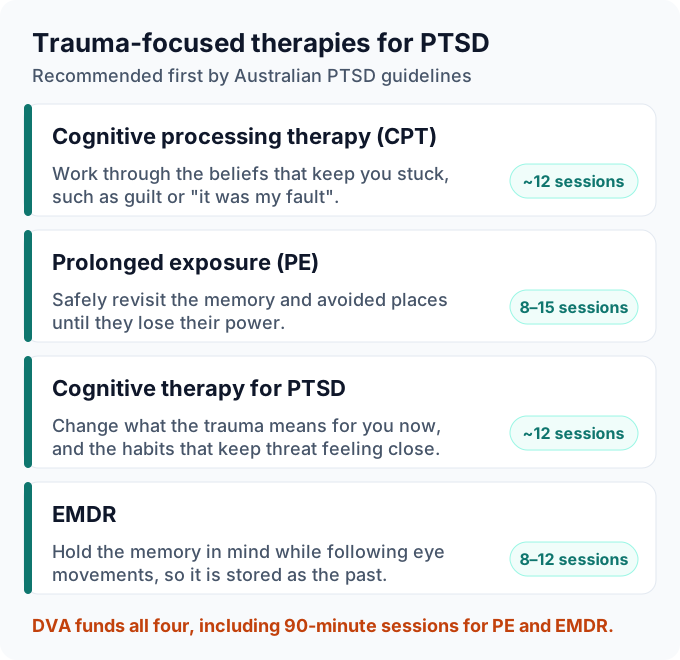
Phoenix Australia's Australian PTSD Guidelines, endorsed by the NHMRC, recommend these trauma-focused therapies most strongly:
| Therapy | What it involves | Typical length |
|---|---|---|
| Cognitive processing therapy (CPT) | Identifying and working through "stuck points": beliefs about the trauma, yourself and the world (for example, guilt or "it was my fault"). Mostly talking and written worksheets. | About 12 weekly sessions |
| Prolonged exposure (PE) | Gradually and safely revisiting the memory in session, and approaching avoided situations in daily life, until they lose their power. | About 8 to 15 sessions, often 90 minutes |
| Trauma-focused cognitive therapy (CT-PTSD) | Changing the meaning of the trauma and the habits that keep the sense of current threat alive. | About 12 sessions |
| EMDR (eye movement desensitisation and reprocessing) | Holding the memory in mind while following side-to-side eye movements or taps, which helps the memory be processed and stored as past. | About 8 to 12 sessions |
| Trauma-focused CBT | An umbrella term that includes elements of the above. | About 8 to 16 sessions |
When trauma-focused therapy isn't suitable or available, guidelines also support other approaches, and medication prescribed by a GP or psychiatrist can help alongside therapy. For complex PTSD, after repeated or prolonged trauma, treatment often begins with skills for managing emotions before trauma processing.
What will therapy actually feel like?
The first one or two sessions are an assessment: what's been happening, what you want to be different, and what's realistic. You decide together which therapy fits. You stay in control throughout, and a good trauma therapist goes at a pace you can manage.
Expect some sessions to be hard. Expect also that, a few weeks in, you may notice you're sleeping a little better, or that a reminder which used to floor you now just irritates you. That is what progress tends to look like: gradual, then noticeable.
How does DVA pay for PTSD treatment?
Under Non-Liability Health Care, DVA funds treatment of any mental health condition, including PTSD, without you having to prove your service caused it.
- You need a Veteran Gold Card, or a Veteran White Card with mental health listed, and a referral from your GP (for the first treatment cycle, a specialist, hospital doctor or discharge planner can also refer). See our step-by-step access guide.
- Standard sessions run in treatment cycles of up to 12 sessions or one year. Your GP can renew the referral as many times as you need.
- Extended trauma-focused sessions are funded separately. DVA has specific items for trauma-focused therapy sessions of 90 minutes or more, in person or by video, for exposure-based work and EMDR when a standard session is too short. Up to 8 of these can be provided without prior approval, and they don't count towards your 12-session treatment cycle. After eight, your psychologist sends DVA a case review and can ask for more.
- You pay nothing. A psychologist who accepts your Veteran Card must accept DVA's fee as full payment.
That extended-session funding matters. Exposure work often needs a longer session to reach the point where distress settles, and DVA is one of the few Australian schemes that pays for it.
Can I do PTSD therapy by telehealth?
Yes. Trauma-focused therapies, including CPT, PE and EMDR, can be delivered effectively by video, and DVA funds both standard and 90-minute trauma sessions by video. The first session of each treatment cycle must be in person or by video, not phone. If there's nobody near you who bills DVA and offers trauma therapy, telehealth widens your choice to the whole country.
How to find a psychologist for PTSD who bills DVA
On ClearAccess Psychology you can search for psychologists who bill DVA and treat PTSD, near you or by telehealth. You can also narrow by approach, for example EMDR or trauma-informed, and by psychologists who work with veterans.
When you contact them, it helps to ask:
- "Do you bill DVA directly, with no gap?"
- "Which trauma-focused therapies do you offer?"
- "Have you worked with veterans or first responders before?"
Picture three months from now: you've had your assessment, you've learned what keeps the memories so close, and the nights are quieter than they were. The path there starts with one inquiry.
Frequently asked questions
Does DVA pay for PTSD treatment if my trauma wasn't from my service?
Yes. Under Non-Liability Health Care, DVA pays for treatment of any mental health condition, including PTSD, for anyone with at least one day of continuous full-time ADF service, whatever caused it.
Does DVA pay for EMDR?
Yes. EMDR is one of the trauma-focused therapies DVA funds, including extended sessions of 90 minutes or more when a standard session isn't long enough.
How many trauma-focused therapy sessions does DVA fund?
Up to eight extended (90-minute-plus) trauma-focused sessions without prior approval, outside the usual 12-session treatment cycle. After eight, the psychologist provides DVA with a case review and can request more.
What is the most effective treatment for PTSD?
Australian guidelines recommend trauma-focused psychological therapies first: cognitive processing therapy, prolonged exposure, trauma-focused cognitive therapy and EMDR. Medication can help alongside therapy.
Do I need a PTSD diagnosis before I can get DVA-funded psychology?
No. Your GP refers you for what you're experiencing, and the psychologist's assessment works out what is going on. Under Non-Liability Health Care you don't need to prove a link to service.
Can my family get support too?
Open Arms – Veterans & Families Counselling offers free counselling to partners and families of anyone who has served, with no referral. Call 1800 011 046.
Sources
- Phoenix Australia, Australian Guidelines for the Prevention and Treatment of Acute Stress Disorder, Posttraumatic Stress Disorder and Complex PTSD
- DVA, Non-Liability Health Care (mental health) for veterans
- DVA, Clinical psychologists and psychologists
- DVA, Schedule of Fees – Psychologists, effective 1 July 2026 (trauma-focused therapy items US52 to US54)
- Open Arms – Veterans & Families Counselling